
Frictional treatment by sliding indenters has been offered for the creation of nanocrystalline layers with especially high level of strength and resistance to heat and wear on the surface of steel products subjected to thermal and chemicothermal treatments. The frictional treatment technology utilizes a new way of steel product processing, which is based on the creation of strain-aged nanocrystalline martensite. The technology and the tool for its realization are optimized on the basis of mathematical modeling. Eddy current non-destructive testing is applied as frictional treatment quality control.
The frictional treatment by sliding indenters or abrasive particles can be effectively used for hardening and nanostructuring of the surface of products of any size and made of high-strength and hard-to-deform (structural, high-speed, or carburized) steels. Hardening frictional treatment applied at machine-building facilities provides an appreciable increase in the durability of steel products subjected to intensive wear and considerable heating (shafts, bearings, cylinder liners, spindles, blades for centerless grinding, tools and instruments, etc.).
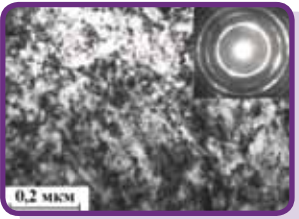
Nanocrystalline structure formed by the frictional treatment in the upper layer of hardened steel U8.
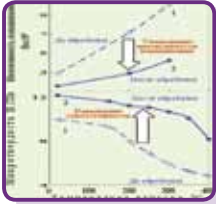
For quenched steel U8, the frictional treatment reduces by a factor of 2 to 3 the intensity of abrasive wear and improves hardness and heat resistance up to the level of the heat resistance of high-alloy steels.
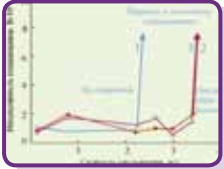
For quenched steel U8, the frictional treatment increases frictional thermal stability, which manifests itself via the transition to the intense thermal seizure at higher sliding velocities: 1—laser quenching; 2—laser quenching + frictional treatment by a hard-alloy indenter; 3 – laser quenching + frictional treatment with abrasive particles.