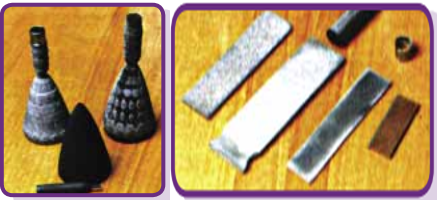
The proposed technology provides continuous coatings of refractory and rare metals, which strongly adhere to the substrate and have various unique physical and chemical properties:
• Coatings of rare and noble metals deposited on products made of more available and cheap refractory metals; hence, the cost of the products is reduced and scarce metals can be saved (Ir on Re, Re on W, Re on Ni).
• Tungsten and molybdenum coatings on copper parts of electronic tubes ensuring a high erosion resistance while the electrical and heat conduction levels are kept at maximum.
• Chromium coatings, which impart suppressor properties to products and possess corro-sion and erosion resistance in air up to suffciently high temperatures (1000--1200OС).
• Needle rhenium coatings, which have properties of the absolute black body and absorb radiation completely, including ion beams, or emit the excess energy well.
• Coatings on carbon materials products, which acquire service properties of refractory or rare metals, while the mass is sharply reduced and rare metals are saved.
• Titanium and chromium coatings on ferrous products making them corrosion and erosion resistant. These composite blanks can be subjected to additional metallurgical treatment.
To expand the performances, the deposited coatings of refractory and rare metals can be treated additionally by electrochemical no-current methods in salt melts (aluminizing, borating, silico-nizing, scandium-plating, lanthanizing, etc.).
ADVANTAGES
• By this technology, the electrolysis temperature is reduced to 600--800°C, leading to a decrease in energy consumption and to a reduction of the cost of coated products.
• Simple monitoring of electrolysis parameters distinguishes the technology from other methods, e.g., the gas-phase technique.
• here is a possibility to deposit coatings on intricately shaped products, which is not always feasible with traditional methods.