
The issue of prosthetic repair of damaged vessels is currently among the top priorities in the theoretical and practical medicine. Generally, host vessels or artificial prostheses are used. A new and promising approach is to grow connective-tissue autoprostheses in the host.
The experiments performed on rats and rabbits have shown a possibility for the development of connective-tissue prosthesis on the PVC scaffold inserted under the skin. The prostheses were used for plastic repair of carotid arteries and femoral arteries of rats and rabbits.
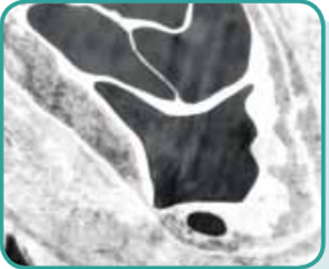
Electron diffraction pattern of a proximal part of the autoprosthesis.
Signs of endothelization and basement membrane formation.
Magnification X7,300.
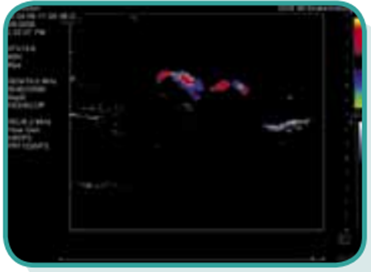
Duplex ultrasound scan of a rabbit’s
femoral artery 6 months after surgery.
The autoprostheses obtained by the proposed technique are featured with biological inertia and a good transplantability owing to the complete antigen compatibility; they are sufficiently strong structures, are able to withstand the blood pressure in carotid and femoral arteries after the transplantation, and retain patency for 6 months. With time, the artery that adjoins the prosthesis and the connectivetissue autoprosthesis acquire almost identical morphological structure.
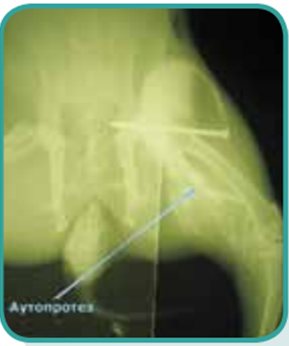
X-ray angiogram of a rabbit’s femoral artery